
How to improve your vocabulary as an adult: what the research says
Adults keep picking up words for decades. Five habits with studies behind them, a weekly routine, and what each one can and can't do.

Photo: Mick Haupt / Unsplash
A large crowdsourced study estimates that the average 20-year-old native speaker of American English knows about 42,000 words, and the average 60-year-old about 48,000. Adults keep adding words long after school ends, and most of those words never come from a class: they arrive through reading and listening, one encounter at a time.
So the practical answer is to make more of those encounters happen, and to get more out of each one. Read more, and read things denser than everyday conversation. When a word stops you, guess its meaning, then check. Learn the common word parts, so you can recognise relatives of words you already know. Arrange to meet new words again. And use them in sentences of your own. Each of these habits has research behind it, most of it with children or with people learning a second language, and none of them needs an app.
Adults do keep learning words
The figures above come from Brysbaert and colleagues (2016), who combined earlier studies with a large online vocabulary test. They counted lemmas, which are roughly dictionary headwords: run, runs and ran count once. Their estimate for 20-year-olds ranges from about 27,000 lemmas for the lowest 5% to 52,000 for the highest 5%. Between 20 and 60, the average person adds around 6,000 more, or "about one new lemma every 2 days". The authors also point out that knowing a word, in their count, "can be as shallow as knowing that the word exists".
A meta-analysis by Verhaeghen (2003) points the same way. Across 324 comparisons of younger and older adults, older adults scored on average 0.80 standard deviations higher on vocabulary tests. These are comparisons between age groups, not the same people followed over time, and education explains part of the gap: on multiple-choice tests it disappeared once education was taken into account, while on tests where people had to come up with the answer themselves, age and education both counted.
The catch is that it gets slower. On Brysbaert's figures, the average 20-year-old has built up around 42,000 lemmas, and the next forty years add around 6,000. Words keep coming, at a much slower pace than before 20, so the five habits below are about getting more from each one.
1. Read more than you talk
Conversation is a poor source of new words. In a well-known analysis, Hayes and Ahrens (1988) counted how many rare words turn up per 1,000 words in different kinds of language. "Rare" here means a word outside the 10,000 most common, roughly a word a fourth to sixth grader wouldn't know. Cunningham and Stanovich reproduced the figures in a 1998 article for teachers; the chart shows some of the categories in their table:
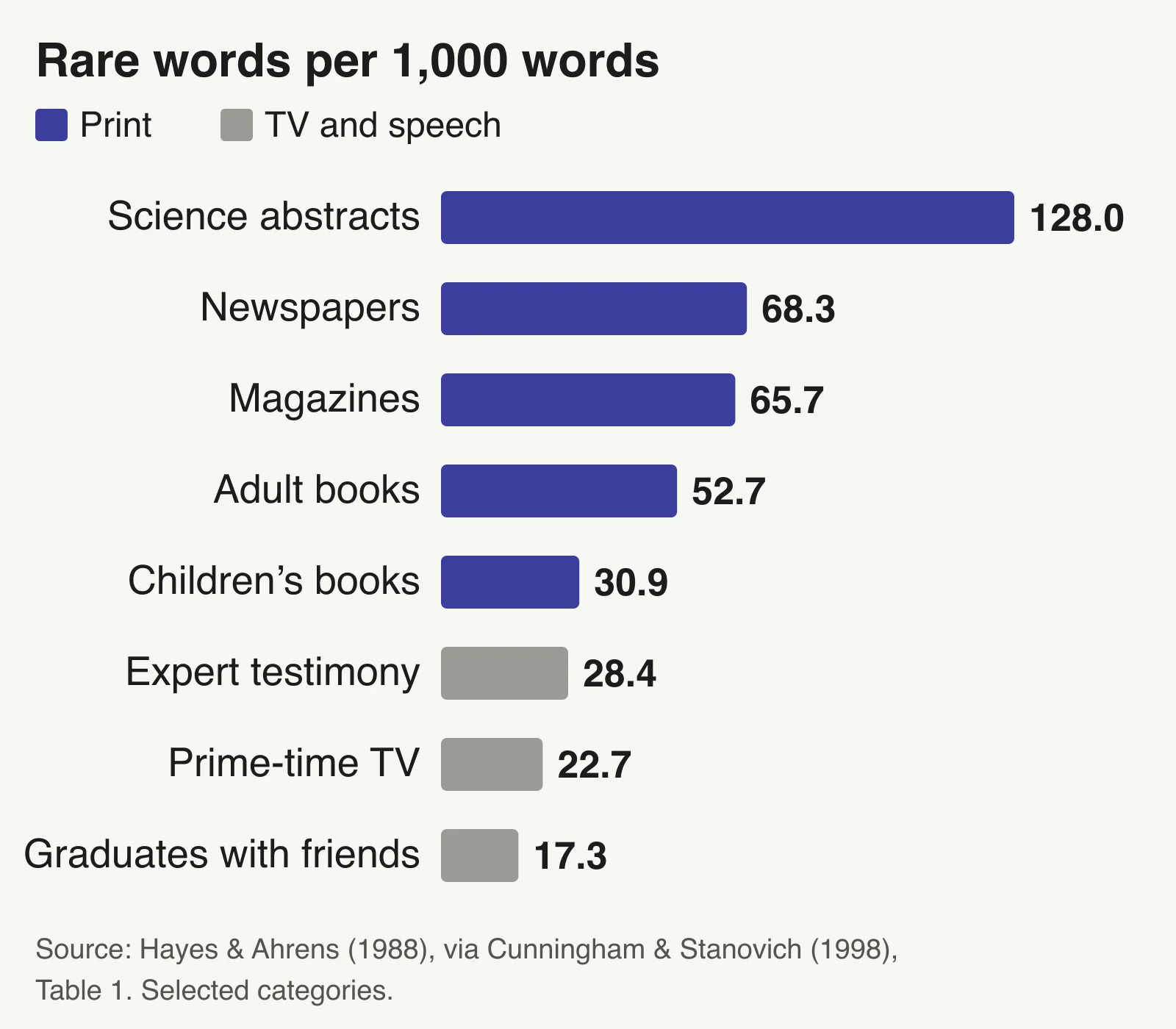
Source: Hayes and Ahrens (1988), Table 1 in Cunningham and Stanovich (1998). Eight of the table's thirteen categories.
College graduates talking to friends and spouses used 17.3 rare words per 1,000. Adult books had 52.7, and newspapers 68.3. Even children's books had more rare words than prime-time adult television. As Cunningham and Stanovich put it, "conversation is not a substitute for reading."
Brysbaert's team made a similar point with a model. By age 20, someone whose only language input was social conversation would have met around 81,000 different word forms; someone reading non-stop, around 292,000. Nobody lives at either extreme, but the gap shows how much of your vocabulary depends on what you read.
Reading habits and language skills also go together over time. A meta-analysis of 99 studies by Mol and Bus (2011) found that the link between leisure reading and oral language skills grew stronger with age: print exposure explained 12% of the variance in preschool and kindergarten children and 34% in college and university students. That is a correlation, not proof that reading caused the difference, although the authors argue the two feed each other.
What to do with this:
- Read one step up. If you mostly read news headlines, try long-form articles. If you read novels, add some non-fiction. Writing on a specialist subject is full of words you won't hear at dinner.
- Change subjects now and then. Every field has its own vocabulary, and a new topic brings a fresh batch.
- Audiobooks count. A book read aloud contains the same words as the printed one. The table compares the words used in different kinds of language, not whether you see or hear them.
2. Guess from context, then check
You pick up a lot from reading without looking anything up. A meta-analysis of 20 experiments by Swanborn and de Glopper (1999) found that school students learned around 15% of the unknown words they met during normal reading. Among the factors that affected the odds were the reader's reading ability and how much text surrounded the word.
Fifteen percent also means that most of the time, a single encounter isn't enough. The same analysis found that results depended on how sensitive the tests were to partial knowledge of a word. That matches a common experience: after one encounter you may have a rough idea of what a word means, enough to keep reading, not enough to use it. Checking fills in the rest. In a review of vocabulary teaching with children, Stahl and Fairbanks (1986) found that the most effective methods gave learners both a definition and the word in context; guessing from the sentence and then reading the dictionary entry gets you both.
What to do with this:
- Don't stop at every word. Mark it (a pencil dot, a highlight, a note on your phone) and keep reading.
- Guess first. Before you look it up, decide what you think it means. It takes a few seconds and tells you how close you were.
- Check at the end of the chapter or article. Read the whole entry, not only the first definition: the example sentence and the etymology often add what the definition leaves out.
- Keep the sentence. Write the word down with the sentence you found it in. How a word is used is part of what it means.
3. Learn word parts
Many words that look new are built from parts you already know. Nagy and Anderson (1984) estimated that for every word a child learns, there are on average one to three related words the child should also be able to understand, depending on how well they can use context and word structure. Their estimate was for children reading school texts, but related words share parts at any age.
The Latin verb dīcere, "to say", is a good example. Wiktionary's etymologies give:
| Word | Built from | Literally |
|---|---|---|
| predict | prae- "before" + dīcō "to say" | to say beforehand |
| contradict | contrādīcō | to speak against |
| verdict | Old French veir "true" + dit "saying" | a true saying |
Old French dit comes from Latin dictum, a form of the same verb. The same root is in dictate and dictionary, which Wiktionary also traces back to dīcō. Once you've spotted it in a few words, you have a head start on the next one.
How strong is the evidence that studying word parts helps? A meta-analysis by Goodwin and Ahn (2013) of 30 studies of morphological instruction in English found a moderate effect on vocabulary (an average effect size of 0.34). Those studies were with school-age children, and the effects were larger for younger students, so there's little direct evidence for adults. The cost is low, though: reading the etymology line when you look a word up takes seconds.
What to do with this: when you check a word, note its root and two or three other words that share it. Over time, group your words by root rather than alphabetically.
4. Meet new words again
One encounter rarely does it. A meta-analysis by Uchihara, Webb and Yanagisawa (2019) pooled 26 correlational studies and found a medium-sized relationship (r = .34) between how many times learners met a word and how well they picked it up. Those studies were with second-language learners; Stahl and Fairbanks reached a similar conclusion for teaching children, finding that effective methods gave "more than one or two exposures" to each word.
Some repetition comes on its own if you read several things on the same subject, because each field keeps reusing its own terms. The rest you can arrange: a list you reread, or flashcards. If you want a system for reviewing cards at growing intervals, our guide to the Leitner box system covers it, with a printable template.
5. Use the words yourself
Recognising a word when you read it and using it when you write or speak are different skills, and the second needs practice of its own. Hulstijn and Laufer (2001) gave learners of English ten unfamiliar words in three tasks: reading a text, reading and filling in the words, or writing a composition with them. Retention was highest in the composition task, lower with reading and filling in, and lowest with reading alone. The participants were learning English as a foreign language and the tasks took different amounts of time, so treat this as a pointer, not a guarantee.
What to do with this:
- Write one sentence of your own for each new word, about something in your life rather than a textbook example.
- Use it within a day or two, in an email, a message or out loud.
- Check the pronunciation in a dictionary before you say a new word out loud, then say it a few times.
A week that puts it together
None of the studies above prescribes a schedule. This is one way to fit the five habits into an ordinary week:
| When | What | About |
|---|---|---|
| Every day | Read something a step denser than usual; mark unknown words | 20 min |
| After reading | Guess, then check two or three words; keep the sentence and the root | 5 min |
| Twice a week | Write a sentence of your own for each recent word | 10 min |
| Sunday | Reread the week's list; drop the words you now know at a glance | 10 min |
Two or three words a day can look like very little. For scale, Brysbaert's estimate for the average adult is about one new word every two days, although checking a word is not the same as keeping it. A short list is also easier to keep up for months.
What an app can and can't do here
WordShot is an app that gives you five new words a day on cards. Each card has a definition, an example, the etymology and the dictionary and headword the word comes from. New words come back in five review boxes, from the next day up to a month later, and every three new cards a question asks you to pick the right definition out of three.
That overlaps with some of the habits above: definition and example together, the word's origin, and seeing it again. It doesn't cover the rest. The words come from WordShot's own bank, written from each language's standard dictionary, not from what you're reading, so it can't replace reading or the words you collect yourself. And it doesn't make you write or say the words in sentences of your own. WordShot runs on iPhone and iPad only.
Frequently asked questions
Is it too late to improve your vocabulary as an adult?
No. On Brysbaert and colleagues' estimate, the average person keeps adding words between 20 and 60, and Verhaeghen's meta-analysis found older adults scoring higher than younger ones on vocabulary tests. The pace is slower than in childhood, which is why habits help more than waiting for words to turn up.
Does reading improve your vocabulary?
Reading puts you in front of far more rare words than conversation or television does. Whether you keep them is another matter: in Swanborn and de Glopper's meta-analysis, school students learned around 15% of the unknown words they came across while reading, so the words you check and meet again are the ones most likely to stay.
How can I improve my vocabulary without reading?
Audiobooks carry the same words as the printed book, so they're the closest substitute. Formal speech is a middle ground: in the Hayes and Ahrens figures, expert witness testimony in court had more rare words than prime-time adult TV or graduates talking to friends, though far fewer than print.
How many words does the average adult know?
It depends on how you count. Brysbaert and colleagues estimate about 42,000 lemmas (dictionary headwords) for an average 20-year-old American, and about 48,000 at 60, with a wide range between people.
How do I start using new words when I speak?
Write a sentence with the word first, then use it in a message or in conversation within a day or two. Check the pronunciation in a dictionary before you try it out loud. In Hulstijn and Laufer's study, learners who wrote with the new words kept more of them than learners who only read them.
How long does it take to improve your vocabulary?
No study gives a timeline for one person, and the studies above didn't follow adults doing these habits. As a reference point, Brysbaert and colleagues estimate that the average adult adds about one word every two days: vocabulary changes over months and years, not days.
Sources
- Brysbaert, M., Stevens, M., Mandera, P. & Keuleers, E. (2016). "How many words do we know? Practical estimates of vocabulary size dependent on word definition, the degree of language input and the participant's age". Frontiers in Psychology, 7, 1116. doi:10.3389/fpsyg.2016.01116, consulted 20 Oct 2026.
- Verhaeghen, P. (2003). "Aging and vocabulary score: A meta-analysis". Psychology and Aging, 18(2), 332–339. doi:10.1037/0882-7974.18.2.332, abstract consulted 20 Oct 2026.
- Cunningham, A. E. & Stanovich, K. E. (1998). "What reading does for the mind". American Educator, Spring/Summer 1998, Table 1, consulted 20 Oct 2026.
- Hayes, D. P. & Ahrens, M. G. (1988). "Vocabulary simplification for children: A special case of 'motherese'?". Journal of Child Language, 15(2), 395–410. doi:10.1017/S0305000900012411; figures as reproduced by Cunningham and Stanovich (1998).
- Mol, S. E. & Bus, A. G. (2011). "To read or not to read: A meta-analysis of print exposure from infancy to early adulthood". Psychological Bulletin, 137(2), 267–296. doi:10.1037/a0021890, abstract consulted 20 Oct 2026.
- Swanborn, M. S. L. & de Glopper, K. (1999). "Incidental word learning while reading: A meta-analysis". Review of Educational Research, 69(3), 261–285. doi:10.3102/00346543069003261, abstract consulted 20 Oct 2026.
- Stahl, S. A. & Fairbanks, M. M. (1986). "The effects of vocabulary instruction: A model-based meta-analysis". Review of Educational Research, 56(1), 72–110. doi:10.3102/00346543056001072, abstract consulted 20 Oct 2026.
- Nagy, W. E. & Anderson, R. C. (1984). "How many words are there in printed school English?". Reading Research Quarterly, 19(3), 304–330. doi:10.2307/747823, abstract consulted 20 Oct 2026.
- Goodwin, A. P. & Ahn, S. (2013). "A meta-analysis of morphological interventions in English: Effects on literacy outcomes for school-age children". Scientific Studies of Reading, 17(4), 257–285. doi:10.1080/10888438.2012.689791, abstract consulted 20 Oct 2026.
- Uchihara, T., Webb, S. & Yanagisawa, A. (2019). "The effects of repetition on incidental vocabulary learning: A meta-analysis of correlational studies". Language Learning, 69(3), 559–599. doi:10.1111/lang.12343, abstract consulted 20 Oct 2026.
- Hulstijn, J. H. & Laufer, B. (2001). "Some empirical evidence for the involvement load hypothesis in vocabulary acquisition". Language Learning, 51(3), 539–558. doi:10.1111/0023-8333.00164, abstract consulted 20 Oct 2026.
- Wiktionary, "predict", "contradict", "verdict", "dit" (Old French), "dictate" and "dictionary", consulted 20 Oct 2026.