
The Leitner box system: how it works, which schedule, and a template
Why no two guides agree on the Leitner schedule, a five-box plan you can start today, and a printable rules card and weekly grid.

Photo: MIKE STOLL / Unsplash
The Leitner box system is a way of deciding which flashcards to review today. Cards sit in numbered boxes. Answer a card correctly and it moves up one box, where it is reviewed less often; get it wrong and it goes back to box 1, where it is reviewed every day. The cards you find easy drift towards the back and stop eating your time, and the ones that trip you up keep coming round until they don't.
That's the whole mechanism. The part people argue about is the schedule: how often each box gets reviewed. There is no official answer, and the guides you'll find disagree with each other. Below is a five-box schedule that we think is a sensible default, the reasoning behind it, and a template you can copy onto paper this evening.
Where the boxes come from
Sebastian Leitner, a German science journalist, described the method in his 1972 book So lernt man lernen ("How to learn to learn"), published by Herder in Freiburg im Breisgau.
His original box was not driven by a calendar at all. It was a single long box divided into compartments of different widths, which Wikipedia gives as 1, 2, 5, 8 and 14 cm. You reviewed a compartment when it filled up. Because the back compartments were wider, cards there waited longer. The schedule was a side effect of the box's shape.
The guides you'll find online describe the calendar version instead: separate boxes, each reviewed on fixed days. That's the one this article uses.
How it works, step by step
- Make the cards. One question per card, the answer on the back. Keep each card to one fact or one word. A card with three things on it gets half right and you can't decide where it goes.
- Everything starts in box 1. New cards always go in the first box.
- Review the boxes that are due today. Take each card, answer it out loud or on scrap paper before you turn it over. Honesty matters more than speed.
- Right answer: up one box. A card in box 2 goes to box 3. A card in the last box either stays there or retires to a "done" pile, your choice.
- Wrong answer: back to box 1. Not down one box, all the way back. That's the rule as Wikipedia and the Drillster guide below describe it.
- Add new cards slowly. Box 1 is where the daily workload lives. If it keeps growing, stop adding cards for a few days.
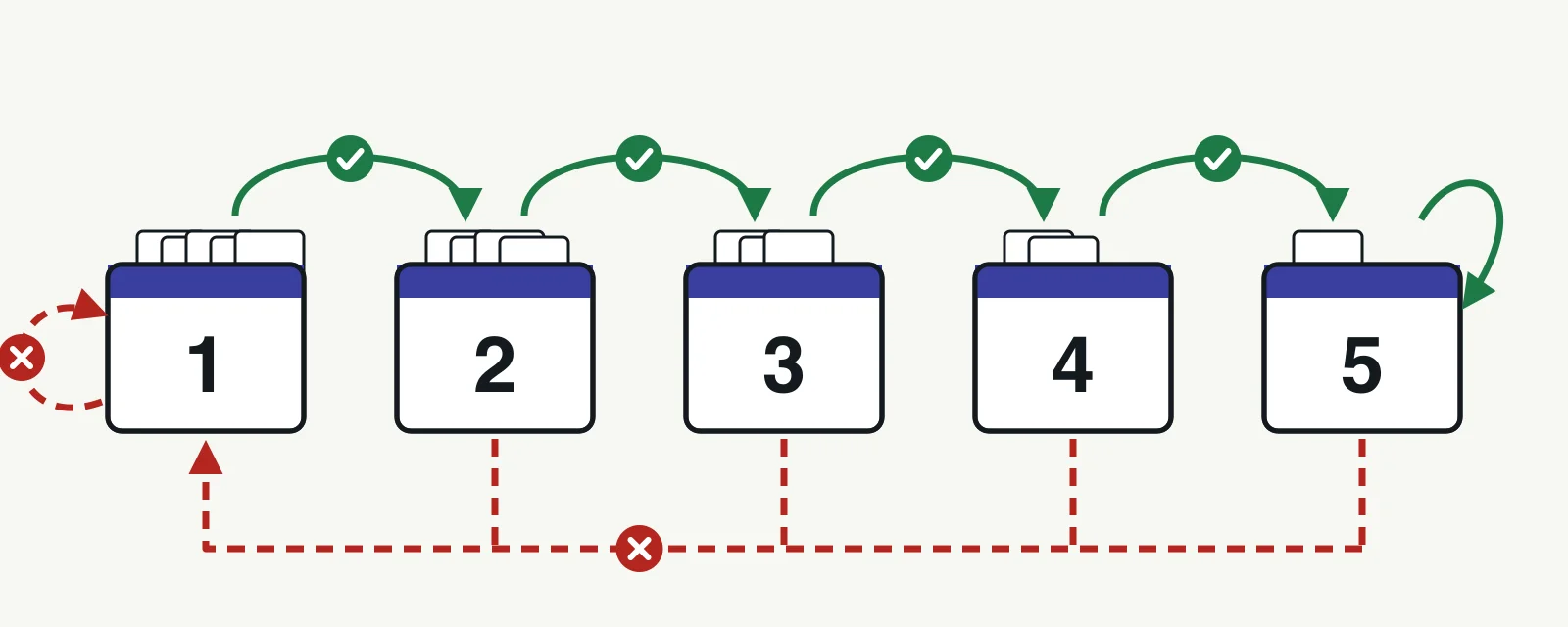
Some people soften rule 5 and drop a missed card only one box. That makes reviews lighter, but a card you've genuinely lost will then take several rounds to get the attention it needs. We'd keep the strict version, at least at first.
Which schedule? Nobody agrees
Look at three popular explanations and you get three different answers:
| Source | Boxes | Intervals |
|---|---|---|
| Wikipedia, "Leitner system" | 3 | every day, every 3 days, every 5 days |
| Drillster blog (Spanish) | 5 | daily, every 2 days, every 4 days, weekly, monthly |
| Brainscape Academy | not fixed | box 1 daily, then longer gaps; "the precise timetable varies" |
None of these is wrong. Leitner's own box ran on compartment size, not days, so everyone has filled the gap their own way.
What the research does give you is a direction. Cepeda and colleagues (2006, Psychological Bulletin) pooled 839 assessments from 317 experiments on spaced practice in verbal recall tasks, such as learning word lists and facts. Their analysis suggests the gap between study sessions and how long you want to retain something work together: the gap that gave the best results grew as the retention period grew. That's the logic behind a Leitner box: short gaps for cards you've just met, longer gaps for cards you've answered correctly several times in a row.
Two broader reviews point the same way. Dunlosky and colleagues (2013) rated ten common study techniques, and distributed practice was one of only two that received their highest utility rating (the other was practice testing). Kang (2016) reviewed the spacing research for educators and concluded that spreading repetitions out produces better long-term learning than massing them together, especially when the repetitions involve testing yourself. A flashcard box combines both: spaced sessions, and every review is a small test. These are averages across many studies, not a promise about how any one person will do.
What none of these papers gives you is a calendar for your shoebox. Any schedule you pick is a reasonable guess, not a finding.
The schedule we suggest
Five boxes, with the gaps roughly doubling from box 2 onwards:
| Box | Review | Gap |
|---|---|---|
| 1 | every day | 1 day |
| 2 | Monday and Thursday | 3–4 days |
| 3 | every Sunday | 1 week |
| 4 | every other Sunday | 2 weeks |
| 5 | first Sunday of the month | about 1 month |
Why this one:
- Box 1 daily, because new and missed cards need a short gap, and because a daily habit is easier to keep than a pattern you have to look up.
- Gaps that roughly double after box 2, because they follow the direction of the spacing research without pretending to more precision than a paper box can deliver.
- Fixed weekdays, because "Monday and Thursday" is something you can remember without a spreadsheet. Pegging boxes 3 to 5 to Sunday puts the longer reviews on one day when you probably have more time.
If your exam is three weeks away, drop box 5 and use four boxes. If box 1 takes more than fifteen minutes a day, you're adding cards faster than you can handle; pause new cards until it shrinks.
Printable template
Print this page and keep the sheets with these two tables, or copy the rules card onto an index card and tape it to the box lid.
The rules card
| Box | Review | Right | Wrong |
|---|---|---|---|
| 1 | every day | to box 2 | stays in box 1 |
| 2 | Monday and Thursday | to box 3 | back to box 1 |
| 3 | every Sunday | to box 4 | back to box 1 |
| 4 | every other Sunday | to box 5 | back to box 1 |
| 5 | 1st Sunday of the month | stays, or retire it | back to box 1 |
The weekly grid
Each cell lists the boxes due that day; tick it once they're done. Two weeks per sheet, so box 4 has a home; box 5, in brackets, only on the first Sunday of the month.
| Day | Week A | Week B |
|---|---|---|
| Monday | ☐ 1, 2 | ☐ 1, 2 |
| Tuesday | ☐ 1 | ☐ 1 |
| Wednesday | ☐ 1 | ☐ 1 |
| Thursday | ☐ 1, 2 | ☐ 1, 2 |
| Friday | ☐ 1 | ☐ 1 |
| Saturday | ☐ 1 | ☐ 1 |
| Sunday | ☐ 1, 3, 4, (5) | ☐ 1, 3, (5) |
What you need: five small boxes or envelopes (or one shoebox with four cardboard dividers), index cards, and a pencil. Number the boxes clearly. If you miss a day, do today's boxes and carry on; don't try to catch up on two days at once.
Leitner boxes or Anki?
Anki is a flashcard program that a Leitner box is often compared with, and the difference is in how the schedule is set.
A Leitner box schedules by box: every card in box 3 gets the same gap. Anki schedules each card on its own. According to Anki's documentation, its original algorithm is based on SuperMemo 2 (SM-2), with changes of its own, and a card's "starting ease" defaults to 2.50, which means a "Good" answer multiplies the interval by roughly two and a half. Since version 23.10, Anki also offers FSRS (Free Spaced Repetition Scheduler), which estimates how well you remember each card and schedules it so you have a chosen chance of recalling it when it comes up; the default "desired retention" is 90%. You grade each answer with one of four buttons instead of a simple right or wrong.
| Leitner box | Anki | |
|---|---|---|
| Who sets the gap | you, per box | the program, per card |
| Answer | right or wrong | four buttons (Again, Hard, Good, Easy) |
| Setup | cards, boxes, a pencil | an app and some settings |
| Large decks (thousands of cards) | gets heavy | handles them |
| Away from screens | yes | no |
Our view: if you have a few hundred cards, want to write them by hand, or are setting it up for a child, paper is simpler and you can see your progress as piles. If you have thousands of cards or a fixed exam date, Anki's per-card scheduling is likely to save you time, and that usually makes up for the effort of learning its settings.
Where WordShot fits
WordShot uses the same box idea for words. Its five review boxes are next day, three days, one week, two weeks and one month. Every three new cards, a question comes up: one word and three definitions, one of them right. Get it right and the word moves up a box; get it wrong and it goes back to the first, the strict Leitner rule. Each day brings five new words plus the ones due for review.
Two limits are worth knowing. WordShot works with its own word bank, written from each language's standard dictionary, with the dictionary and headword named on each card. If what you need to drill is a list of your own, such as exam terms or a textbook chapter, the paper template above or Anki is the more direct route. And WordShot runs on iPhone and iPad only; there's no Android version.
Frequently asked questions
How many boxes should a Leitner system have?
Three to five is common. Three boxes are fine for a short-term goal, like a test in two weeks. Five give you room for gaps of a month, which suits material you want to keep for longer.
What happens if I get a card wrong in the last box?
In the strict version, it goes back to box 1, like any other missed card. It feels harsh, but a card you've lost after a month needs short gaps again.
Can I use the Leitner system without physical boxes?
Yes. Envelopes, rubber-banded piles or a ring binder with tabs all work. What matters is that you can tell which box a card is in and which boxes are due today.
How many new cards should I add per day?
Enough that box 1 stays manageable. A rough limit is the number you can review in ten to fifteen minutes. If box 1 keeps growing, add fewer.
Is the Leitner system the same as spaced repetition?
It's one form of it. Spaced repetition is the general idea of reviewing at growing intervals; the Leitner box is a simple, manual way to do it, and programs like Anki do it per card with an algorithm.
Sources
- Wikipedia, "Leitner system", consulted 19 Oct 2026.
- Leitner, S. (1972). So lernt man lernen: angewandte Lernpsychologie, ein Weg zum Erfolg. Freiburg im Breisgau: Herder. Record in the Deutsche Nationalbibliothek catalogue, consulted 19 Oct 2026.
- Cepeda, N. J., Pashler, H., Vul, E., Wixted, J. T. & Rohrer, D. (2006). "Distributed practice in verbal recall tasks: A review and quantitative synthesis". Psychological Bulletin, 132(3), 354–380. doi:10.1037/0033-2909.132.3.354; abstract at USF Digital Commons, consulted 19 Oct 2026.
- Dunlosky, J., Rawson, K. A., Marsh, E. J., Nathan, M. J. & Willingham, D. T. (2013). "Improving students' learning with effective learning techniques". Psychological Science in the Public Interest, 14(1), 4–58. doi:10.1177/1529100612453266; summary in the APS release "Which study strategies make the grade?", consulted 19 Oct 2026.
- Kang, S. H. K. (2016). "Spaced repetition promotes efficient and effective learning: Policy implications for instruction". Policy Insights from the Behavioral and Brain Sciences, 3(1), 12–19. doi:10.1177/2372732215624708, consulted 19 Oct 2026.
- Anki Manual, "Deck Options", consulted 19 Oct 2026.
- Anki Manual, "What spaced repetition algorithm does Anki use?", consulted 19 Oct 2026.
- Drillster, "¿Sabías que … la repetición espaciada se aplicó por primera vez con un sistema de tarjetas?", consulted 19 Oct 2026.
- Brainscape Academy, "What Is the Leitner Method?", consulted 19 Oct 2026.